

If you have an open Oregon claim, you have probably signed more than one form with an 8 and a 2 in it, and the difference is easy to lose track of. Oregon workers’ compensation Form 827 is the one you complete at the doctor’s office, and unlike the form that opens your claim, it comes back around at several points as your treatment continues. Workers who understand what the 827 does, and when it needs to be filed, keep their claims on track. Workers who do not can watch benefits stall over a form they did not know they had to sign.
This guide explains what the 827 is, how it differs from its better-known sibling Form 801, the specific jobs it performs, and why it matters throughout ongoing treatment. You can find the current version on our Oregon workers’ compensation forms page, and at Schoenfeld & Schoenfeld we walk injured workers across Hood River, The Dalles, and Eastern Oregon through each of these steps.
Also Read
- How to File Oregon Workers’ Comp Form 801
- How Oregon Workers’ Comp Works
- Oregon Time-Loss Benefits Explained
Form 827 in One Minute
Form 827, the “Worker’s and Health Care Provider’s Report for Workers’ Compensation Claims,” is the Oregon form you and your medical provider fill out together at the point of care. It has four main jobs: it can start a claim at your first medical visit, request that the insurer accept a new or omitted medical condition, notify the insurer that you are changing your attending physician, and file an aggravation claim if an accepted condition worsens after your claim closed.
Each use has its own deadline, usually measured in days, and the provider is responsible for sending the completed form to the insurer. Where Form 801 is the report you give your employer, the 827 is the report that runs through your doctor. It keeps appearing throughout your claim, which is why knowing how it works protects your benefits.
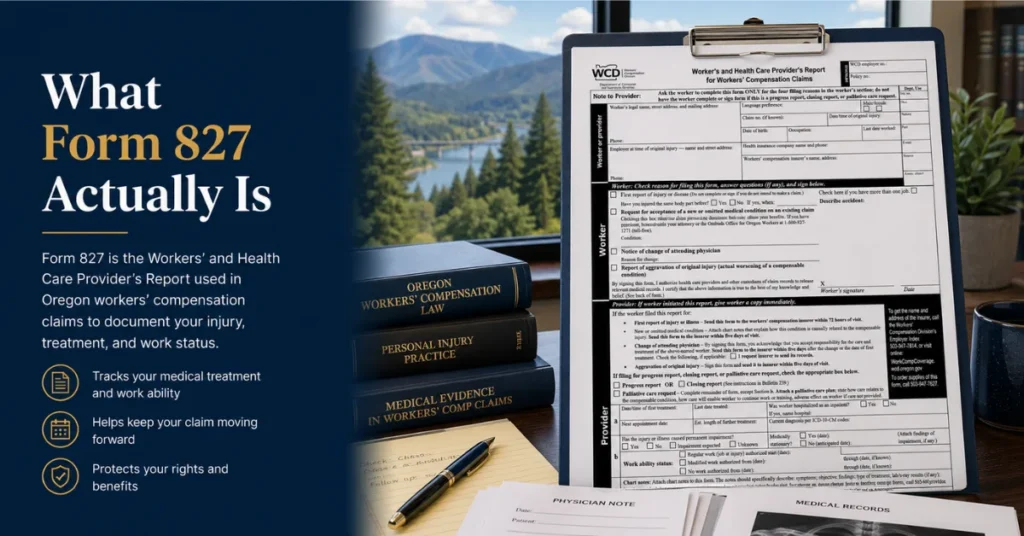
What Form 827 Actually Is
The 827 form is a state form governed by Oregon’s workers’ compensation law, ORS Chapter 656, and its implementing administrative rules. Under OAR 436-010-0241, it is the “Worker’s and Health Care Provider’s Report,” and it is designed to be completed jointly by the injured worker and the health care provider treating the injury. You can view the actual document, in English and Spanish, through the state’s official 827 form.
What makes the 827 distinctive is that it lives at the intersection of your medical care and your legal claim. Your signature on it can serve as written notice of a work injury, and your provider’s portion documents the medical side. Because it carries both, the form is not a one-time document you file and forget. It is a tool the system uses again and again whenever something about your medical situation changes.
Form 827 vs Form 801: Two Forms, Two Jobs
Injured workers mix these up constantly, and the confusion is understandable, because both forms can start a claim. The clearest way to keep them straight is to remember who you are standing in front of when you sign each one.
Form 801: You and Your Employer
Form 801 is the “Report of Job Injury or Illness.” You complete the worker section and hand it to your employer, who must forward it to its workers’ compensation insurer. It is the employer-side record that you reported the injury, and it is usually the first thing you do after getting hurt. If you want the full walkthrough, our guide on how to file Form 801 covers it step by step.
Form 827: You and Your Doctor
The 827 is what you complete at the clinic or hospital with the provider treating you. When you sign it at that first visit, it can also open a claim, and the provider must send it to the insurer within 72 hours. In practice, many workers end up with both: an 801 filed through the employer and an 827 filed through the doctor, both pointing at the same injury from different directions. The 827 is the one that keeps coming back as treatment continues.
Not sure which forms your claim still needs? A missing or late form is one of the simplest reasons a claim stalls, and one of the easiest to fix with guidance. Get clarity in a complimentary consultation with an experienced Oregon workers’ comp attorney.
The Four Jobs Form 827 Does
The reason the 827 shows up repeatedly is that Oregon uses one form for several distinct purposes. Each has its own trigger and its own deadline.
1. Starting a Claim at the Doctor’s Office
When you seek treatment for a work injury, you and the first provider complete the 827, and it functions as a report of the injury. The provider must submit it to the insurer within 72 hours of that first visit, not counting weekends and holidays.
2. Adding a New or Omitted Medical Condition
Injuries evolve. A shoulder claim can reveal nerve involvement; a back injury can turn out to include a disc problem that was not named at the start. You use the 827 to ask the insurer to formally accept a new or omitted condition, and after you sign, the provider sends it in within five days. This step matters enormously, because the insurer only pays for conditions it has actually accepted.
3. Changing Your Attending Physician
Your attending physician is the provider chiefly responsible for your treatment, and Oregon rules limit how and when you can switch. When you change attending physicians, you and the new provider complete an 827, which the provider must submit within five days of taking over your care. Keeping this current avoids disputes over who is authorized to direct your treatment and your work status.
4. Filing an Aggravation Claim
If your condition was declared medically stationary and your claim closed, but the accepted injury later worsens, you may be able to reopen it through an aggravation claim. That claim is filed on the 827, signed by you and your attending physician, and submitted within five days of the exam that documents the worsening. Miss the mechanism, and a legitimate worsening can go unaddressed.
A worsening injury deserves a second look. If an accepted work injury has flared up after your claim closed, an aggravation claim may reopen your benefits, but the deadline is short. Talk it through in a complimentary consultation or call 971-703-7543.

Why the 827 Matters for Ongoing Treatment
Here is the piece workers underestimate. Your ongoing workers’ comp treatment in Oregon is guided by your attending physician, and the paperwork that documents changes in your condition drives real benefits. When a new condition is accepted, the insurer becomes responsible for treating it. When your physician documents that you cannot work or can only do light duty, that medical opinion is what supports your time-loss wage payments. The 827 is one of the primary vehicles for recording these changes as they happen.
That is also why small slips have outsized consequences. A new condition that never gets submitted on an 827 is a condition the insurer can refuse to treat. A late aggravation filing can cost you a reopening you were entitled to.
The form looks routine, and most of the time it is, but the moments when it is not are exactly the moments that decide what your claim is worth. Oregon’s Workers’ Compensation Division publishes the forms, and the state bar’s workers’ compensation overview is a useful plain-language starting point, but neither will fill the form out for you or catch a missed deadline on your behalf.
Signs Your 827 Needs Attention
Most claims hum along without drama. Still, a few situations should prompt you to ask whether an 827 needs to be filed or followed up on.
- Your symptoms have spread or changed, and a condition you are now being treated for was never named in your claim.
- You want to switch to a different doctor and are not sure the change was ever reported to the insurer.
- Your claim closed, but the same injury has clearly gotten worse since then.
- You are being kept off work or put on restrictions, and you are not certain your provider’s reports are reaching the insurer.
- The insurer is paying for some treatment but denying other care tied to the same injury.
Any one of these is a reason to slow down and confirm the paperwork is right before a deadline passes.
Conclusion
Oregon workers’ compensation Form 827 is easy to dismiss as just another piece of paper, and that is precisely the mistake that costs workers benefits. It opens claims, adds conditions, changes doctors, and reopens worsened injuries, and each of those jobs comes with a deadline that does not forgive being missed. Understanding the form turns it from a hazard into a tool.
At Schoenfeld & Schoenfeld, keeping claims correctly documented is daily work. Steve Schoenfeld has handled thousands of Oregon workers’ compensation matters, and our small firm gives injured workers in the Gorge and Eastern Oregon the personal attention to make sure a form like the 827 helps their claim instead of quietly derailing it. This article is general information, not legal advice, and your claim depends on its own facts, so reach out if you want a careful look at yours.
Worried a form or deadline slipped through the cracks? Bring us your claim, and we will make sure the right paperwork is filed and nothing is left on the table. Contact Schoenfeld & Schoenfeld or call 971-703-7543 to schedule your complimentary consultation.