
Having a pre-existing condition doesn’t bar a workers’ comp claim in Oregon, and the belief that it does keeps people from filing claims they would win. Almost everyone past thirty has something on an MRI. Degenerative disc disease, arthritis, an old shoulder injury from a different job. None of that makes you ineligible, any more than being partly at fault for the injury does. It changes the question the law asks.
That question is about cause. When a work injury combines with a condition you already had, Oregon asks whether the work injury is the major contributing cause of your disability or need for treatment. Insurers lean on this standard heavily, and it is behind a large share of the denials we see. If your claim was refused on these grounds, our guide to appealing a denied Oregon claim walks through the deadline and the process, and our Oregon workers’ compensation FAQ covers the surrounding rules.
Also Read
- Denied in Oregon? How to Appeal a Workers’ Comp Claim Denial Step by Step
- Occupational Hearing Loss Claims in Oregon
- How to File Form 801 in Oregon
TL;DR
You can file an Oregon workers’ comp claim with a pre-existing condition. When a work injury combines with a prior condition, Oregon treats it as a combined condition, and it is compensable “only if, so long as and to the extent that” the work injury remains the major contributing cause of the disability or need for treatment. Major contributing cause means the work injury contributed more than all other causes combined. Oregon handles a worsening of a condition the insurer already accepted as an aggravation claim, which has its own five-year window measured from your first notice of closure. The practical fight is almost always medical opinion, which makes what your doctor writes the center of the case.
Key Points
- A pre-existing condition doesn’t disqualify you. Oregon law contemplates combined conditions directly and provides for when they are compensable.
- The test is major contributing cause. The work injury has to contribute more than all other causes combined to the disability or the need for treatment.
- Major contributing cause weighs the work injury against everything else combined. Contributing more than any one other factor isn’t enough.
- Compensability can change over time. The statute makes a combined condition compensable “only if, so long as and to the extent that” the work injury remains the major contributing cause, which is why insurers issue later denials on accepted claims.
- Aggravation is a different route. If an already accepted condition worsens, you file an aggravation claim rather than a new injury claim.
- Aggravation claims run five years from first closure. For a disabling claim, the period runs from the first notice of closure, and the worsening has to be shown with objective findings.
- Missing work is not proof of worsening. The statute says absence from work or inpatient treatment alone does not establish a worsened condition.
- The insurer will read your medical history closely. Prior records, old imaging, and earlier complaints all come in, so accuracy from the first report forward protects the claim.
Told your claim was denied because of a prior condition? That denial rests on a legal standard with a specific meaning, and insurers frequently apply it too broadly. Book a consultation, and we will look at what the medical record actually supports.

The Combined Condition Rule and Major Contributing Cause
When a work injury combines with a pre-existing condition, Oregon calls it a combined condition and applies a specific test. Under ORS 656.005(7), the combined condition is compensable “only if, so long as and to the extent that” the otherwise compensable injury is the major contributing cause of the disability of the combined condition or of the need for treatment.
Two parts of that sentence do most of the work.
The first is major contributing cause. The statute uses the phrase and never defines it; the courts did. A persuasive medical opinion has to explain why the work injury contributed more to the condition than all other causes or exposures combined, not merely more than the next largest one. That is the standard applied in Bowen v. Fred Meyer Stores, 202 Or App 558, 123 P3d 367 (2005), rev den, 341 Or 140 (2006). It’s a real burden: a work injury accounting for a third of the picture is not the major contributing cause, even if no other single factor accounts for more.
The second is “so long as and to the extent that.” Compensability isn’t fixed at the moment of acceptance. If the insurer later argues that the work injury is no longer the major contributing cause and that your ongoing symptoms are now driven by the underlying condition, it can deny a claim it previously accepted. This often blindsides workers. The insurer isn’t changing its mind arbitrarily. It’s the statute’s structure, and you can contest it.
Aggravation: When an Accepted Condition Gets Worse
A separate path applies when an insurer-accepted condition worsens after your claim closed. That is an aggravation claim under ORS 656.273, and it is a different filing with different requirements.
Under ORS 656.273(2) and (3), the claim goes on the form the director prescribes, signed by you or your representative and by your attending physician, and is filed with the insurer or self-insured employer. If that party cannot be located, is unknown, or no longer exists, it goes to the DCBS Director instead. The timing matters: for a disabling claim, you have five years from the first notice of closure. For a claim classified as nondisabling for at least a year after acceptance, the five years runs from the date of injury.
You have to show an actual worsening of the compensable condition supported by objective findings. The statute is explicit that being off work or spending time in the hospital does not by itself establish that the condition worsened. And if you previously received a permanent disability award, the worsening has to be more than the ordinary waxing and waning of symptoms that award already accounted for.
One more limit: the worsening is not compensable if its major contributing cause is an injury that happened outside the course and scope of employment. If you reinjured the same back lifting furniture at home, expect that to be the insurer’s argument.
Has an accepted condition started getting worse again? Whether that is an aggravation claim or a new injury claim changes the deadline, the filing, and who signs it. See how Oregon handles reopened and worsening claims.
Why These Cases Turn on Medical Opinion
Major contributing cause is a medical question that doctors answer, and a judge decides. That has practical consequences for how you handle your claim from day one.
Be accurate and complete about your history. Workers sometimes downplay a prior injury, worried it will sink the claim. Downplaying does the opposite. When the insurer finds the old record, and it will, the omission damages your credibility on everything else. A prior injury you disclosed is a fact. A prior injury you concealed is an argument.
Describe the change, not just the pain. The persuasive version is comparative: what you could do before and can’t do now. Six years of full duty without treatment, then an inability to lift after a specific incident. That is the shape of a winning causation opinion.
Make sure your doctor has the whole file. An attending physician opinion written without the prior imaging is easy for the insurer’s expert to pick apart. The strongest opinions address the pre-existing condition directly and explain why the work injury is still the larger cause.
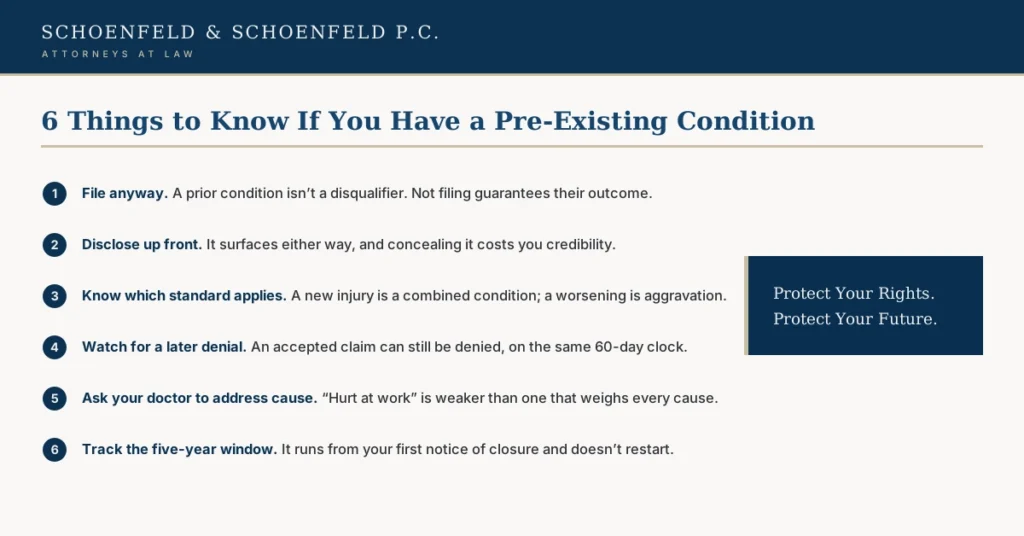
6 Things to Know If You Have a Pre-Existing Condition
If you’re deciding whether to file, or your claim was just denied on these grounds, start here.
- File anyway. A pre-existing condition isn’t a disqualifier, and not filing guarantees the outcome the insurer wants.
- Disclose the history up front. It will surface regardless, and disclosing it costs you far less than concealing it.
- Know which standard applies. A new injury to a previously injured body part is a combined condition question; a worsening of an accepted condition is an aggravation question.
- Watch for a denial on an accepted claim. The combined-condition rule lets insurers deny later, and that denial carries the same 60-day appeal deadline.
- Ask your doctor to address causation directly. A note that says you were hurt at work is weaker than one that explains why the work injury is the major contributing cause.
- Track the five-year aggravation window. It runs from your first notice of closure on a disabling claim, and it doesn’t restart.
Pre-existing condition denials are among the most contested in Oregon workers’ comp and among the most reversible.
Conclusion
A prior condition changes what has to be proved in an Oregon workers’ comp claim, not whether you are allowed to bring one. The combined condition rule asks whether the work injury is the major contributing cause of your disability or need for treatment, and an aggravation claim asks whether an accepted condition actually worsened on objective findings within the five-year window. Both are medical questions, and both are won or lost on the quality of the opinion in your file.
Schoenfeld & Schoenfeld has represented injured workers throughout Oregon since 1991, from offices in Hood River and Portland. This article is general information, not legal advice, and the answer in any individual claim depends on the medical record.