
If you are trying to work out how to appeal denied workers’ comp in Oregon, the most important thing to know is that the clock started the day the insurer mailed the denial letter, not the day you opened it. You have 60 days from that mailing date to request a hearing with the Workers’ Compensation Board. Miss it, and you can lose the right to compensation on that claim entirely.
A denial isn’t a final judgment on whether you were hurt at work. It’s one insurance company’s position, and that position gets tested in front of an Administrative Law Judge who doesn’t work for the insurer. We have handled thousands of Oregon workers’ compensation hearings from our Hood River and Portland offices, and we can tell you that denials get reversed often enough that giving up on one is almost always the wrong move. If you want the broader picture of how claims work before you dig into the appeal, our Oregon workers’ compensation FAQ covers the system end to end.
Also Read
- Pre-Existing Conditions and Oregon Workers’ Comp: When a Work Injury Still Counts
- How Oregon’s Workers’ Compensation System Works
- Oregon Time-Loss Benefits: How Much You Get Paid and When
TL;DR
If your Oregon workers’ comp claim is denied, you have 60 days from the date the insurer mailed the denial to file a request for hearing with the Workers’ Compensation Board. A late request can still be heard up to 180 days after mailing, but only if you prove good cause for the delay. After 180 days the right is gone, with one narrow exception for lack of mental competency. The request itself is simple: a signed writing that says you want a hearing and gives your address, the denial date, the claim number, and your injury date. From there the case goes to an Administrative Law Judge, then to Board review if either side appeals, then to the Court of Appeals. Mediation is available at any point.
Key Points
- The deadline runs from mailing, not receipt. Under Oregon law, the 60 days is measured from the day the insurer mailed the denial, so a letter that sat in your mailbox for a week has already eaten part of your window.
- Sixty days is the rule, and 180 days is the absolute ceiling. Between day 61 and day 180, you can still get a hearing, but you have to show good cause at the hearing for why you were late.
- A request for hearing doesn’t have to be a formal document. Any signed writing that asks for a hearing and includes your address will satisfy the statute.
- You can file five different ways. Mail, email, fax, hand delivery to a staffed Board office, or electronic filing through the WCB Portal.
- Filing an appeal can’t cost you your job. The required denial notice says so directly: “By law, your appeal cannot affect your employment.” Separately, ORS 659A.040 makes it an unlawful employment practice to discriminate against a worker for applying for or inquiring about workers’ comp benefits, invoking the ORS 656 procedures, or giving testimony.
- An ALJ hearing is a real evidentiary proceeding. Testimony, medical records, and expert opinion all come in, and the judge is independent of the insurer.
- Partial denials are common and easy to miss. An insurer can accept a claim and still deny a specific body part or condition within it, which limits what treatment gets paid.
- Attorney fees in Oregon workers’ comp usually don’t come out of your pocket. The fee structure is set by statute and rule, which is why a consultation costs you nothing to find out where you stand.
Not sure how many days you have left? The date on the envelope matters more than the date you read the letter, and the difference decides whether you still have a claim. Book a consultation and we’ll work out your deadline with you.
What a Denial Actually Means
When an insurer denies a claim, it says one of a handful of things, and which one matters for how you fight it. It may say the injury did not happen at work. It may accept that something happened but argue your current symptoms come from something else, such as an old injury or a degenerative condition. It may deny only part of the claim, accepting a lumbar strain while refusing the disc herniation your doctor documented a month later. Or it may be a procedural denial issued because the insurer says you did not cooperate with its investigation.
The denial letter has to tell you why, and it has to tell you what comes next. Under ORS 656.262(9) and OAR 436-060-0140(8)(a) and (8)(c), the insurer has to give the factual and legal reasons for the denial and tell you about the Expedited Claim Service and your right to a hearing. A separate Board rule, OAR 438-005-0055, requires your appeal rights in prominent or bold-face type, and supplies the language carrying the 60-day deadline, the good-cause exception, and the 180-day cutoff. Read it closely because the stated reason tells you what evidence will actually decide your case. You win a causation denial with medical opinion. You often win a procedural denial by showing what you did and when.
A denial isn’t a determination by a neutral party. No judge has looked at your file at this stage. The insurer’s claims examiner made a decision, and Oregon built an appeal process precisely because those decisions are sometimes wrong. The Workers’ Compensation Division’s guide for injured workers is blunt about the fact that you have the right to challenge it.

The 60-Day Deadline and the 180-Day Ceiling
People lose winnable claims here. Under ORS 656.319, a hearing on a denial cannot be granted unless the request is filed no later than the 60th day after the denial was mailed to you.
Note the wording. Not 60 days after you received it. Not 60 days after you understood what it meant. Sixty days after the insurer put it in the mail. If the letter was forwarded, if you were in the hospital, if it went to an old address, the clock was still running the whole time.
The statute builds in a second chance, and it’s narrower than most people assume. If you file between day 61 and day 180, the Board can still hear the case, but only if you prove good cause at the hearing for why the request was late. Good cause is a real legal standard, not a sympathetic explanation, and you carry the burden. After the 180th day the statute closes the door, with one narrow exception. Under ORS 656.319(2), lack of mental competency can extend the filing period by up to five years, and never more than one year after competency returns. Subsection (3) limits that to a mental or nervous disorder of the kind that would support commitment or voluntary admission, so it’s narrower than it sounds.
If you are reading this and the denial is already more than 60 days old, that’s a reason to call someone today rather than assume it’s over.
How to Request a Hearing With the Workers’ Compensation Board
The filing itself is less intimidating than the deadline. Under ORS 656.283(2), a request for hearing is any writing signed by or for the party asking, giving that party’s address, stating that a hearing is desired, and mailed to the Workers’ Compensation Board. No particular form is required, and the Board accepts four other filing routes alongside mail. The Board publishes a fill-in Request for Hearing and Specification of Issues, and using it is the cleanest route because it prompts you for everything that should be there.
Include the following: a statement that you want a hearing, your address, the date of the denial, the claim number, and the date of your injury or exposure if you know it. The Board’s filing instructions for hearing requests list five ways to get it there:
- Mail to the Workers’ Compensation Board, 2601 25th St. SE, Suite 150, Salem, OR 97302
- Email the completed form to request.wcb@wcb.oregon.gov, copying the other parties and their attorneys
- Fax to 503-373-1600
- Hand deliver to any permanently staffed Board office during business hours
- File electronically through the WCB Portal if you are a registered user
If you file by email and don’t get an automated reply confirming receipt, do it again and check the address. Proof of timely filing becomes the whole case if the Board receives your request after day 60, so keep the certified-mail receipt, the fax confirmation, or the automated email reply.

What Happens at the Hearing
Your case goes to an Administrative Law Judge in the Board’s Hearings Division. This is an evidentiary hearing, not a paperwork review. You testify. Your medical records come in. The insurer typically presents a medical opinion from a physician who examined you or reviewed your file, and your attending physician’s opinion goes on your side.
Most denied Oregon claims turn on medical causation, so the hearing often comes down to which doctor the judge finds more persuasive and why. That is less about credentials than about which opinion the history supports: what you reported, when you reported it, what the imaging shows, and whether the physician had the full record.
The ALJ issues a written order. If you win, the ALJ sets aside the denial and the insurer processes the claim. Either side that disagrees with the order can appeal it to the full Board for review and then to the Oregon Court of Appeals. Each step has its own deadline, which is another reason to have someone track the dates daily.
Is the medical evidence in your file strong enough to win a hearing? You can usually answer that question well before the hearing date, and the answer shapes everything you do next. Read more about how Oregon claims are decided, or talk it through with our team.
Where Mediation Fits
Mediation is available and underused. Either side can request it through the Workers’ Compensation Division or through the Board, and it can happen before a hearing or while one is pending. A mediator doesn’t decide your case. They work with both sides to see whether an agreement is possible.
For a denied claim, mediation often leads to a Disputed Claim Settlement, where the insurer pays an agreed amount to resolve a claim it continues to deny. That’s a real option with real trade-offs. Understand them before you’re sitting in the room being asked to decide.
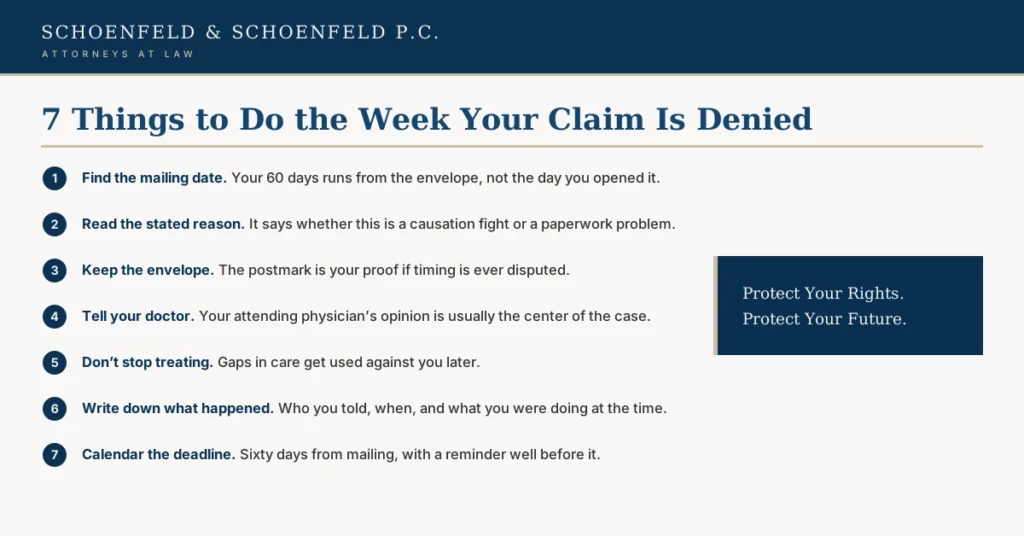
7 Things to Do the Week Your Claim Is Denied
If the denial arrived in the last few days, work through this list before anything else.
- Find the mailing date. Look at the letter and the envelope. Your deadline runs from that date, not today’s.
- Read the stated reason. It tells you whether this is a causation fight, a partial denial, or a procedural problem, and you fight each one differently.
- Keep the envelope. If there’s ever a dispute about timing, the postmark is evidence.
- Tell your doctor the claim was denied. Your attending physician’s opinion is usually the center of the case, and your doctor needs to know the claim is contested.
- Don’t stop treating. Insurers use gaps in treatment as evidence that the condition resolved, and they’re hard to explain away later.
- Write down what happened while it’s fresh. Who you told, when, what you said, and what you were doing when you got hurt.
- Get the deadline on a calendar. Sixty days from the mailing date, with a reminder well before it.
None of that requires a lawyer. All of it is easier with one.
Conclusion
Appealing a denied Oregon workers’ comp claim is a defined process with a hard front-end deadline. You have 60 days from the mailing of the denial to request a hearing, and 180 days as an outer limit with good cause. After that comes an evidentiary hearing before an independent judge, with Board review and the Court of Appeals behind it. The request itself takes minutes. Preparation decides the outcome.
Schoenfeld & Schoenfeld has represented injured workers across Oregon since 1991, from offices in Hood River and Portland, and Steven Schoenfeld has tried well over 1,000 workers’ compensation cases. This article is general information, not legal advice, and every claim turns on its own facts and medical record.