

Understanding how workers’ comp settlements work in Oregon starts with a fact that surprises most people: Oregon has two separate settlement vehicles; they apply to different situations; and signing the wrong one closes doors you may need later. A Claim Disposition Agreement and a Disputed Claim Settlement aren’t two names for the same thing.
Alongside both sits the permanent partial disability award, which isn’t a settlement at all but a benefit calculated under a statutory formula. Knowing which of the three is on the table and what each one permanently resolves is the difference between an informed decision and a signature you regret. Our recent workers’ compensation results show the range of outcomes these cases produce.
Also Read
- Denied in Oregon? How to Appeal a Workers’ Comp Claim Denial Step by Step
- Oregon Time-Loss Benefits: How Much You Get Paid and When
- How Oregon’s Workers’ Compensation System Works
TL;DR
Oregon has two workers’ comp settlements. A Claim Disposition Agreement resolves an accepted claim and releases your rights to compensation, attorney fees, and penalties, with one major exception: medical services survive it. A Disputed Claim Settlement resolves a claim the insurer has formally denied, where compensability itself is in bona fide dispute. Both require approval: a CDA from the Board, and a DCS from an Administrative Law Judge, the Board, or a court. Separate from either, a permanent partial disability award pays for impairment and adds work disability if you have not returned to or been released for your regular job. Value turns on impairment rating, wage at injury, work restrictions, and acceptance status.
Key Points
- A CDA applies to an accepted claim. It disposes of any or all matters regarding the claim in exchange for payment.
- A CDA doesn’t release medical services. Statute carves medical benefits out, which is the single most important thing to understand before signing one.
- A DCS applies to a denied claim. It resolves a bona fide dispute over compensability, and the claim generally stays denied.
- Neither settlement is effective on signature alone. A CDA goes to the Board for approval; a DCS requires approval by an ALJ, the Board, or a court.
- A CDA has a 30-day disapproval window. A party can request disapproval within 30 days of submission, and where you were represented by an attorney when you signed, the agreement itself may provide for waiving it.
- PPD is a calculated benefit, not a negotiation. Impairment is rated as a percentage of the whole person under state standards.
- Work disability can increase the award substantially. It applies when you have not returned to or been released for your job at injury, and it adjusts for age, education, and adaptability.
- Your wage at injury feeds the formula. The statute ties the work-disability calculation to your weekly wage, bounded against the state average weekly wage.
Has the insurer put a settlement offer in front of you? Which agreement it is and what it closes off matter more than the number on the first page. Book a consultation before you sign anything.
Claim Disposition Agreements
A Claim Disposition Agreement, usually called a CDA, is the settlement used on an accepted claim. Under ORS 656.236, the parties can agree to dispose of any or all matters regarding a claim, except for medical services.
That exception is the key. Unless the agreement says otherwise, a CDA resolves your rights to compensation, attorney fees, and penalties arising out of the claim. Future time-loss, future permanent disability, future vocational assistance: gone. Medical treatment for the accepted condition survives. A worker who signs a CDA and later needs surgery on that body part still has the medical side of the claim.
A CDA isn’t final when you sign it. It has to be filed with the Board for approval, and approval comes by final order unless the agreement is unreasonable as a matter of law, resulted from intentional misrepresentation of a material fact, or a party requests disapproval within 30 days of submission. Where you were represented by an attorney when you signed, the agreement itself may provide for waiving that 30-day period. No separate statutory cooling-off right exists beyond that window, but one path remains after approval: under OAR 438-009-0035, a party can move for reconsideration within 10 days of the date the order was mailed, decided by the ALJ who mediated the agreement or by the Board. Understand both before you sign, not after.
A CDA really asks what the rest of your claim is worth to you as a lump sum today, against what it might pay out over years if you leave it open. That depends on whether your condition is stable, whether you’re working, and how likely further disability is.

Disputed Claim Settlements
A Disputed Claim Settlement, or DCS, does a different job. Under ORS 656.289(4), a DCS resolves a claim where compensability is in bona fide dispute. The Board’s rules put structure around it: OAR 438-009-0010(2)(b) and (2)(c) require the settlement to recite the denial and its date and to state that a bona fide dispute exists, and under (7) an Administrative Law Judge or the Board has to find both that the dispute is genuine and that the terms are reasonable before approving it.
That is the structural difference. A CDA settles a claim everyone agrees is compensable. A DCS settles the argument about whether it is compensable at all. The insurer pays an agreed amount without conceding the claim, and the denial generally stands.
Because the claim remains denied, a DCS does not leave behind open medical benefits the way a CDA does. For a worker weighing a DCS against pressing on to hearing, the trade is certainty now versus the possibility of an accepted claim with ongoing medical coverage. Which way that cuts depends entirely on the strength of the medical evidence, which is why these decisions come after the parties develop the evidence, not before.
A DCS also requires approval by an ALJ, the Board, or a court. And under ORS 656.289(5), a claim resolved this way is not eligible for reimbursement from the Workers’ Benefit Fund without the Director’s prior approval.
Permanent Partial Disability
PPD isn’t a settlement. It’s a benefit you’re owed if you have permanent impairment from an accepted condition, and it’s calculated rather than negotiated. It matters here because it’s often the number underneath a settlement discussion.
Under ORS 656.214, a PPD award covers permanent impairment, and in some cases impairment plus work disability. Impairment is the loss of use or function of a body part or system caused by the compensable condition, rated under state standards as a percentage of the whole person.
Which formula applies depends on your work status. If you have returned to the job you held at injury or been released to regular work, the award is based on impairment alone. If you have not, work disability is added, which adjusts the impairment value for age, education, and adaptability to perform a given job, then multiplies it against your weekly wage at injury within statutory bounds.
Two workers with identical injuries can receive very different awards. An older worker with limited education who can’t return to their trade is in a different position under this formula than a younger worker released back to the same job.
What Actually Drives Value
Identifiable factors drive settlement value in Oregon, not how badly the injury hurt.
Acceptance status. An accepted claim is worth more than a denied one because the insurer’s exposure is defined rather than speculative.
Impairment rating. The percentage assigned under state standards is the foundation of any PPD calculation and anchors the discussion.
Wage at injury. It feeds the work disability formula directly and sets the scale of the award.
Work restrictions and work status. Whether you have been released to regular work changes which formula applies, and that difference is often the largest single variable.
Future medical exposure. For a CDA, the medical treatment you are likely to need affects what the parties think the open claim is worth, even though medical isn’t released.
Strength of the medical evidence. On a disputed claim, how a hearing is likely to come out shapes what a DCS is worth to each side.
We don’t quote expected amounts, and no one honestly can without the file. Oregon bar rules also limit what firms may suggest about likely results, for good reason. We can tell you which factors are in play in your claim and how they interact.
Want to know which factors are driving value in your claim? Impairment, wage, work status, and acceptance all pull in different directions, and the mix is specific to your file. See the results we have obtained for injured Oregon workers.
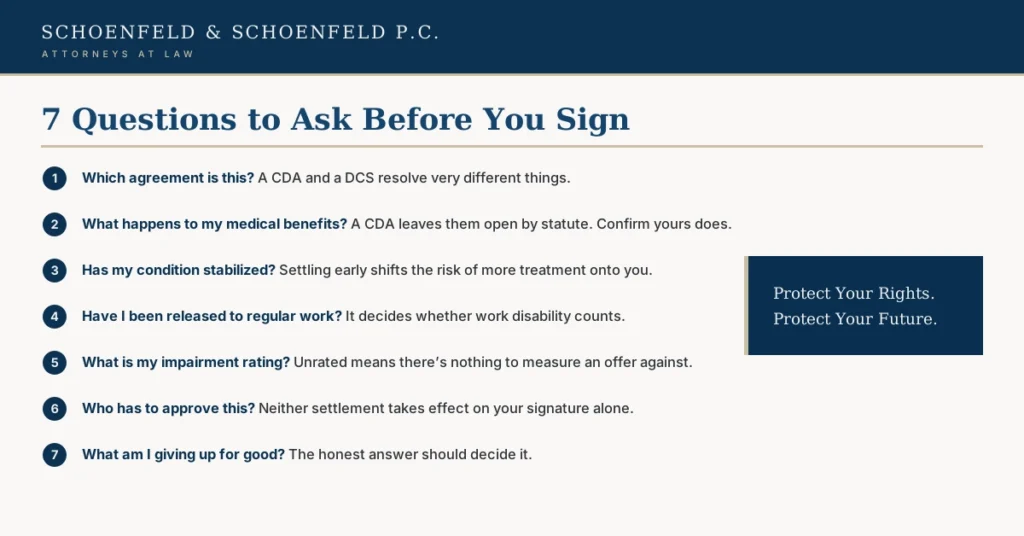
7 Questions to Ask Before You Sign
Before you agree to any Oregon workers’ comp settlement, get clear answers to these.
- Which agreement is this? A CDA and a DCS resolve different things, and the name on the document tells you which rules apply.
- What happens to my medical benefits? A CDA leaves medical services open by statute. Confirm the document doesn’t say otherwise.
- Has my condition stabilized? Settling before you know whether you need further treatment shifts that risk onto you.
- Have I been released to regular work? It determines whether work disability is part of the PPD calculation.
- What is my impairment rating? If no one has rated it, there may be nothing to measure an offer against yet.
- Who has to approve this? Neither settlement takes effect on signature, and the approval step carries its own timing.
- What am I giving up that I cannot get back? The honest answer to this question is the one that should decide it.
A settlement you understand is a reasonable outcome. A settlement you don’t is a risk you took without knowing it.
Conclusion
Oregon workers’ comp settlements come in two forms that are easy to confuse and have very different effects. A Claim Disposition Agreement resolves an accepted claim and releases compensation while preserving medical services. A Disputed Claim Settlement resolves a formally denied claim where compensability is genuinely contested. Permanent partial disability sits alongside both as a calculated benefit driven by impairment, wage, and work status. Which one applies depends on the facts of your claim.
Schoenfeld & Schoenfeld has represented injured Oregon workers since 1991 from Hood River and Portland, and Steven Schoenfeld has tried well over 1,000 workers’ compensation cases. This article is general information, not legal advice, and nothing here predicts a result in any particular claim.